
Should Women Over 40 Take Creatine? What the Research Says

Updated: Jun 13
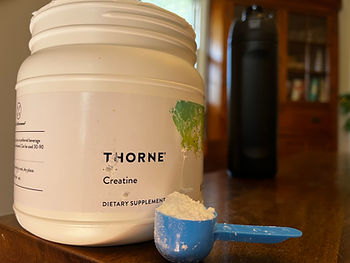
When people hear the word creatine, they often picture bodybuilders, pre-workout powders, and giant tubs of supplements.
But creatine isn't some exotic performance enhancer. It's actually a compound your body already makes and uses every day.
In fact, creatine helps power nearly everything you do—from getting up out of a chair to completing a heavy set of squats to concentrating through a busy afternoon.
And while it has long been popular in the fitness world, researchers are discovering that its benefits may extend far beyond the gym.
Why Do We Need Creatine?
Every movement you make requires energy.
Your body stores and uses that energy in the form of ATP (adenosine triphosphate), often called the body's energy currency.
The catch? Your muscles only store enough ATP for a few seconds of intense effort.
Fortunately, your body has a backup system.
Creatine is stored in your muscles as creatine phosphate. Think of it as a rechargeable battery. When ATP runs low, creatine phosphate helps regenerate it quickly, allowing you to continue producing force and movement.
This is one reason creatine has become one of the most researched and effective supplements for improving strength and exercise performance.
Creatine Isn't Just for Muscles
What surprised me most when I first started learning about creatine wasn't what it does for muscles—it was what it might do for the brain.
Your brain is one of the most energy-hungry organs in your body. Just like your muscles, it relies heavily on ATP to function.
Researchers have found that increasing creatine stores may help support cognitive performance, particularly during periods of stress, sleep deprivation, or mentally demanding work.
While we still have more to learn, emerging research suggests creatine may help reduce mental fatigue and support memory and focus in certain situations.
For many of us juggling work, family, aging parents, changing hormones, and everything else life throws our way, that's an exciting area of research.
Why Creatine May Be Especially Helpful for Women Over 40
One of the reasons I've become increasingly interested in creatine is because of its potential role in healthy aging.
As women move through perimenopause and menopause, maintaining muscle mass becomes more important—and more challenging.
We naturally lose muscle as we age, which can affect:
Strength
Metabolism
Balance
Bone health
Daily function
Strength training remains the most powerful tool we have for preserving muscle and independence as we age.
Creatine may help support those efforts by improving training performance and recovery, making it easier to continue building and maintaining strength over time.
While creatine isn't a magic solution, it may be one of the simplest and most affordable supplements available to support an active lifestyle.
Will Creatine Make Me Bulky?
This is probably the question I hear most often.
The short answer is no.
Creatine does increase water storage inside muscle cells. Because of this, some people notice that their muscles look a little fuller or firmer within the first few weeks.
You may even see a small increase on the scale.
That's not body fat.
It's simply additional water being stored within the muscle tissue itself.
For most people, this creates a stronger, healthier appearance—not a bulky one.
How Much Creatine Should You Take?
For most healthy adults, the recommendation is simple:
3–5 grams per day.
Consistency matters far more than timing.
You don't need a complicated loading phase. You don't need to cycle on and off.
You simply take it daily and allow your body's creatine stores to gradually increase over time.
What About Side Effects?
Creatine is one of the most extensively studied supplements in the world and has a strong safety profile in healthy individuals.
That said, some people experience mild digestive discomfort when they first begin taking it.
A few things that can help:
Stay well hydrated.
Start with a smaller dose and gradually increase.
Split your daily serving into two smaller doses if needed.
Choose a simple creatine monohydrate supplement rather than a proprietary blend.
Personally, I use creatine monohydrate from Thorne because it is third-party tested and contains exactly what I expect it to contain—nothing more.
The Bottom Line
The supplement industry is full of products that promise the world.
Creatine is different.
It's affordable, well researched, and supported by decades of evidence for improving strength and exercise performance. Researchers are also continuing to explore its potential benefits for brain health and healthy aging.
If you're a woman over 40 who is already strength training—or thinking about starting—creatine may be one of the few supplements worth considering.
Not because it's flashy.
Because it works.
And sometimes the simplest tools end up being the most useful.
xo,
Amy
References
Kreider, R. B., et al. (2017). International Society of Sports Nutrition position stand: Safety and efficacy of creatine supplementation in exercise, sport, and medicine. Journal of the International Society of Sports Nutrition, 14(18). https://doi.org/10.1186/s12970-017-0173-z
Rae, C., et al. (2003). Oral creatine monohydrate supplementation improves brain performance: a double–blind, placebo–controlled, cross–over trial. Proceedings of the Royal Society of London. Series B: Biological Sciences, 270(1529), 2147–2150. https://doi.org/10.1098/rspb.2003.2492
Persky, A. M., & Brazeau, G. A. (2001). Clinical pharmacology of the dietary supplement creatine monohydrate. Pharmacological Reviews, 53(2), 161–176.


Comments